Man of steel emphasizes leadership skills, AI and work-life balance

By Vicki Christian
Fisher College of Business
Great leaders understand the importance of key skills such as open communication, gaining trust, building high-performing teams, navigating organizational change and leveraging technology in business.
These are qualities that Geoff Gilmore, president and chief executive officer at Worthington Steel, regularly utilizes in leading the more than 70-year-old Columbus-based company. He talked about these leadership traits and offered students a glimpse into the steel industry during April’s LeadX: Unplugged speaker series at Fisher.
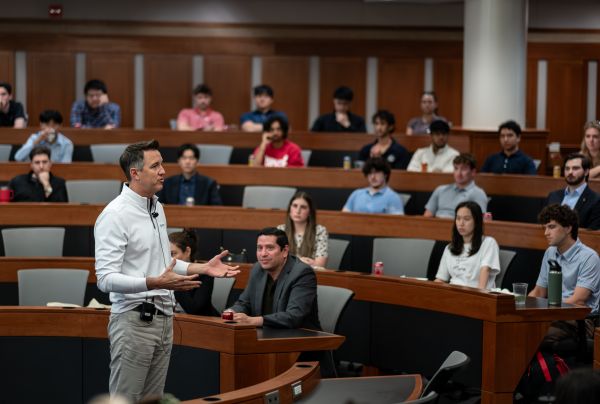
Gilmore, who leads Worthington Steel’s operations and long-term strategy, including its growth in electrical steel and value-added processing, also shared with students his career journey. He began in sales before advancing to manufacturing operations management and purchasing, including roles as executive vice president and chief operating officer of Worthington Industries, the predecessor to Worthington Steel before it became an independent, publicly traded company in 2023.
“His career path and steady move up in the company to a corporate setting was unique,” said Mykhailo “Misha” Sydir, a third-year finance student. “He made me realize I need to be open to learning and that I don’t have to know everything all at once.”
Gilmore said Worthington Steel is leaning into technology and the use of AI in business, calling it a significant opportunity to act as a workforce multiplier.
“My expectation is that AI is a part of everyone’s everyday job,” he said. “We began using large language models, generative AI and ChatGPT in our daily work, which has led to a shift in how we think about solving problems.”
Recently, Worthington Steel began using agentic AI, a large reasoning model, in some pilot supply chain and operations management programs with early positive results. Gilmore sees agentic AI as a strong opportunity to transform not only administrative functions but also the manufacturing floor by creating more streamlined and efficient processes.
“We are thinking things through from end-to-end and getting buy-in from everyone on these AI projects,” he said. “One way we’re doing this is gaining trust from our employees. While there is an expectation they use AI, we are using it to work faster and more efficiently, not to replace jobs. We hired our employees for their brain power; we want them to spend 80% of their time on the 20% of work that drives the most value.”
While Worthington Steel is intentionally using AI to enhance how work gets done, Gilmore noted that roles will continue to evolve as technology advances, creating new opportunities alongside changing job responsibilities.
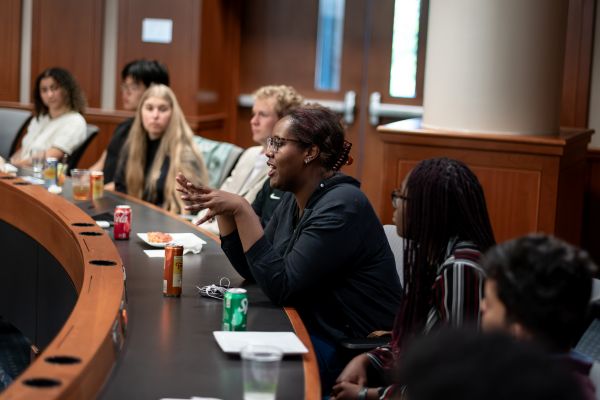
“We’re being taught in our classes about how to use AI and its importance in business, but I was surprised to find that AI applications in business are really still quite new,” said Sabrina Khurshe, a fourth-year accounting student.
Gilmore said students should understand how AI works, learn to use it and develop strong prompting and analytical skills as they enter the workforce. In addition, he said a successful career requires communications skills, the ability to collaborate with team members, business partners and clients, and critical thinking.
“His discussion on leadership made me realize how important both hard and soft skills, including AI and communication, are for business success,” said Grace Min, a third-year finance student.
One of the biggest lessons Gilmore learned as a leader came when he was asked to lead a business that had grown through acquisitions, with a focus on integrating operations and driving performance improvements. With limited prior experience in that part of the business, he initially moved quickly to implement change.
“When you make big changes, your pace matters,” Gilmore said. “Just because I was ready as the president, didn’t mean that the couple thousand employees in the division were ready. Everyone goes at a different pace. My vision wasn’t bad. I just hadn’t established the culture for the team to be ready for change.”
To help build that culture of trust, Gilmore focuses on clearly communicating his vision, adapting his approach for different audiences, outlining how goals will be achieved and building a high-performing, accountable team.
To become a strong leader, he advised students to focus on mastering their role, becoming the go-to resource on their team and continuing to learn and grow.
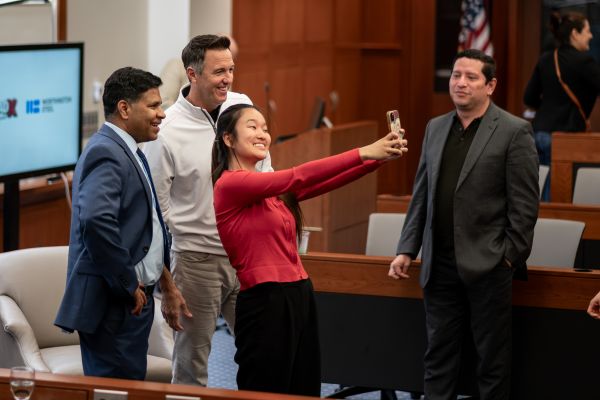
Keeping his “vital few” priorities front and center helps Gilmore focus on what matters most, both personally and professionally. Tracking how he spends his time against those priorities helps him stay aligned.
“I appreciate his approach to work-life balance and how he spends his time focusing on things that are a priority,” Min said. “His discussion of his personal life seemed to be very important to his success.”
Gilmore said part of keeping that balance includes evaluating a company’s culture and employee development opportunities before accepting a job.
A strong advocate for workforce development, he supports internal leadership initiatives that invest in talent at every stage of the career journey, including lifelong educational opportunities, like those through its partnership with Fisher.
“At Worthington Steel, we apply the Golden Rule: treat others how you want to be treated,” he said. “We have long-term employees because of the culture and development opportunities we offer.”
As a student who will graduate in December 2026, Khurshe appreciated the advice.
“Knowing what questions to ask about the company culture and employee development, rather than focusing on salary and work-from-home opportunities, was helpful for me to identify any red flags,” she said.
For many students, Gilmore’s presentation offered an eye-opening introduction to the opportunities within the manufacturing industry.
“Listening to his career journey and about the steel industry helped me learn about a very different field,” Sydir said. “It gave me an understanding and different perspective that has helped me better understand what career path I might want to take.”
“His discussion on leadership made me realize how important both hard and soft skills, including AI and communication, are for business success.”