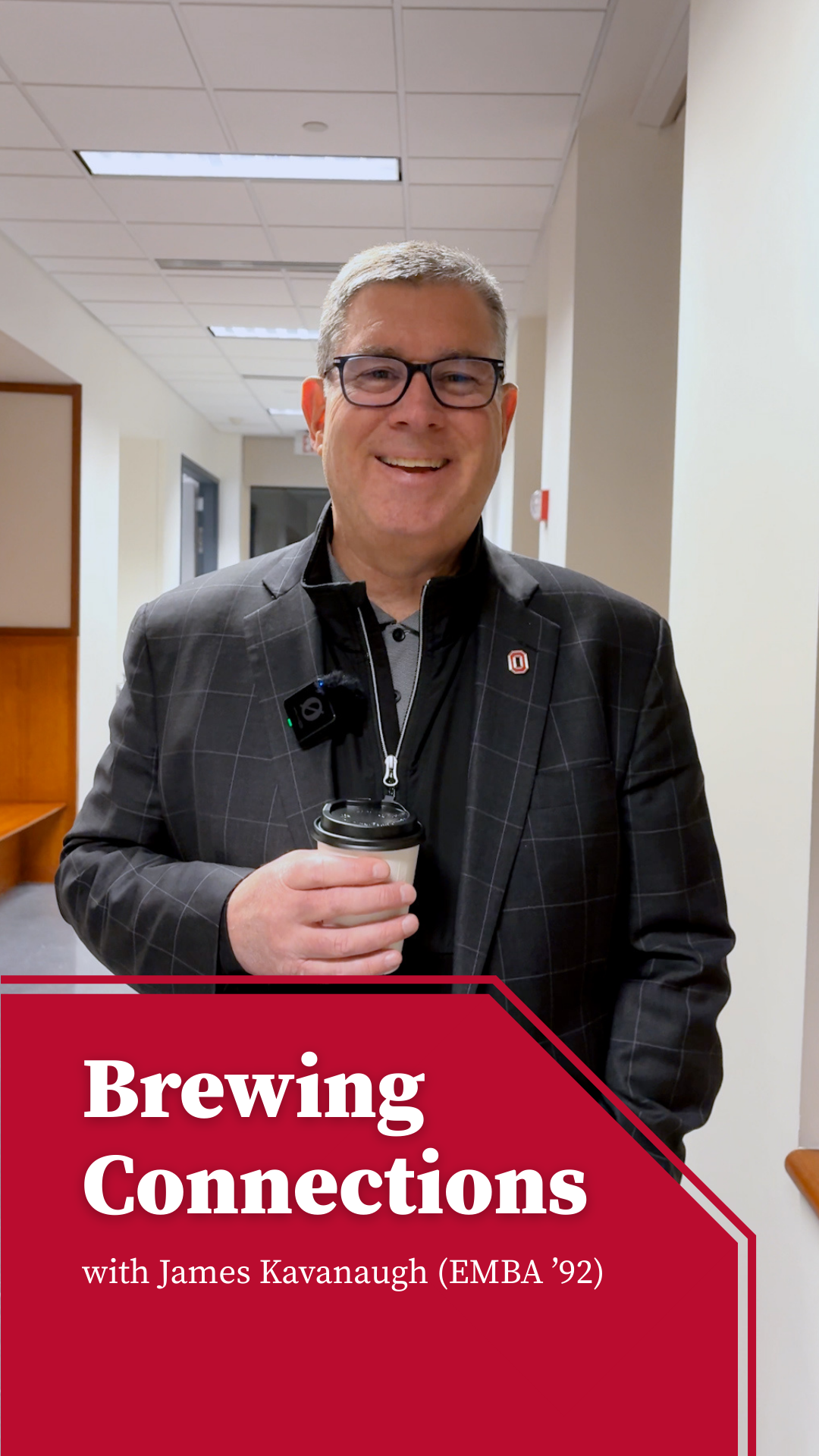
IBM’s James Kavanaugh (EMBA ’92) talks leadership through reinvention

By Vicki Christian
Fisher College of Business
An insatiable appetite for learning, a passion for technology and innovation, and a core set of values have led James Kavanaugh’s journey of growth, discovery and making a difference. Now as the senior vice president and CFO at IBM, he’s guiding the company’s evolution from the age of personal computing into today’s frontier of artificial intelligence and hybrid cloud innovation.
Kavanaugh (EMBA ’92) reflected on his 30-year career at IBM as part of Fisher’s LeadX: Unplugged speaker series, giving students advice about technology, innovation and finding their passion in life.
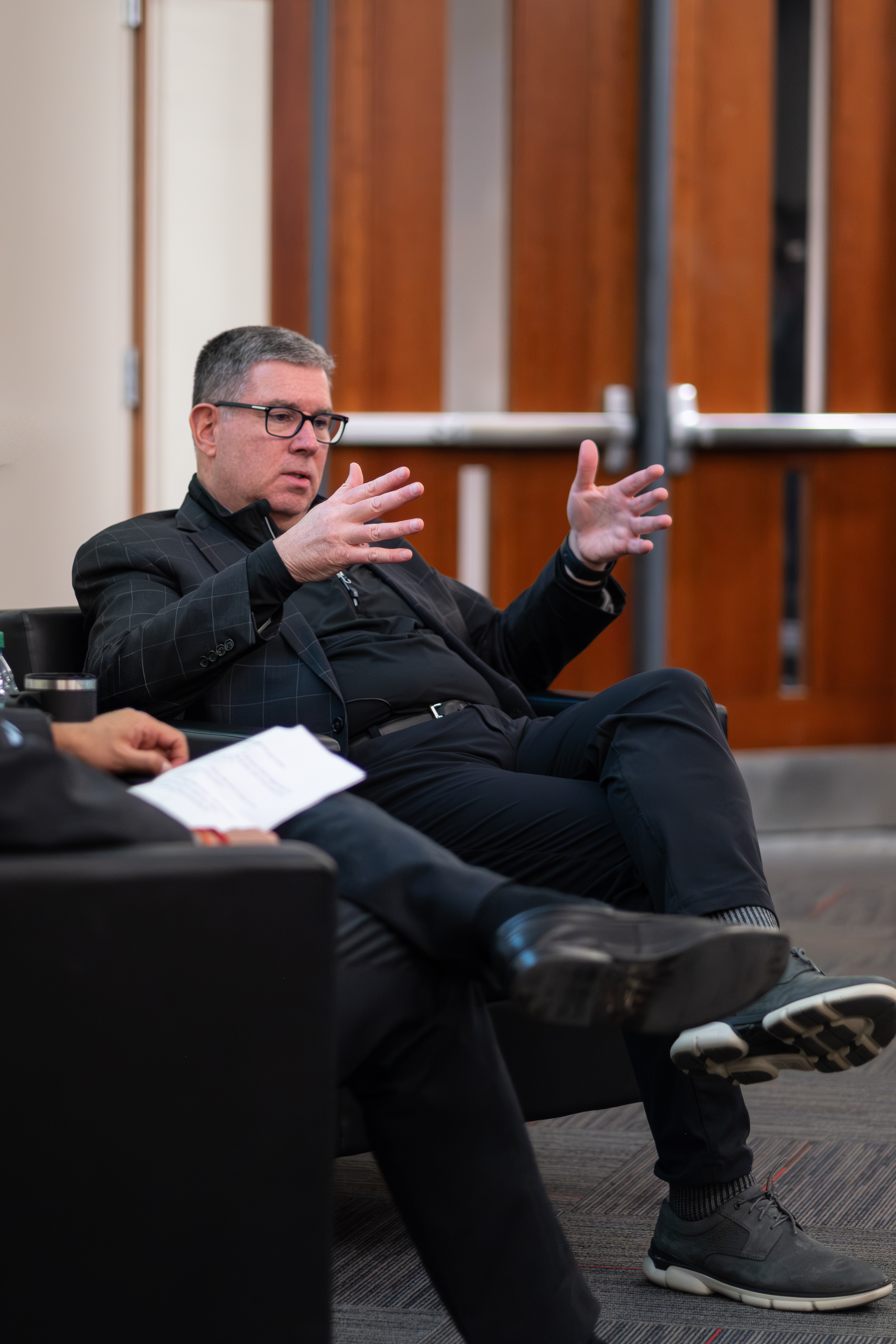
“My father always told me to find my purpose in life and pursue it with passion,” Kavanaugh said. “Life gives us a set of opportunities and challenges. What we do with them defines who we are.”
Early in life, he followed his passion for athletics and football. But when an injury ended his football career he reflected on his future and decided to return to the Midwest and pursue his finance degree from the University of Dayton.
In 1987, he received four offers from firms on Wall Street, but they disappeared with the Black Monday stock market crash in October of that year. Instead, Kavanaugh landed at National Cash Register (NCR) in Dayton, Ohio, where he discovered new technologies and their ability to shape the world.
In 1996, a recruiter convinced Kavanaugh to visit IBM in New York. Even though the company was going through a massive restructuring at the time, he fell in love with the organization and has been with it ever since, now strategically leading its innovation and reinvention with integrity and wisdom.
“Hearing him speak about his career journey gave me concrete examples of how to become a principled leader by applying business ethics and staying true to your own values,” said Kunsh Puranik, a fourth-year logistics student.
To be successful, Kavanaugh advised students of the essential skills for anyone looking to go into business:
- Communication and how you use it to move and influence people
- Systemic thinking that separates operators and strategists
- Utilizing AI and technology as though they were teammates to provide a competitive edge over others
- Understanding industry and business and how you make money and value
- Treating networks as relationship capital ― earned trust and long-term valuable assets.
He also stressed the need to take risks in order to grow, both personally and professionally.
“I surround myself with people who are different from me,” Kavanaugh said. “When you do that, you learn and the entire organization learns. One of the most underappreciated leadership traits is listening. I want to learn different points of view.”
While he said that there’s nothing wrong with a passion for excellence, students shouldn’t be afraid of learning through failure.
“Risk and growth are not mutually exclusive; growth and comfort don’t co-exist,” Kavanaugh said. “It’s important to learn about success and failure; both are important.”
Olivia Tyka, a fourth-year operations and logistics management student, found that taking risks has helped her grow professionally.
“I know that I like to take things relatively safe,” said Tyka. “But after hearing Mr. Kavanaugh, I realized that the risks I took in some of my internships in retail, social media, at an art gallery overseas and a consulting company truly differentiated me and made me grow in my operational knowledge.”
Kavanaugh said he took a huge risk leaving NCR to work at IBM: the company lost $8 billion the year before he came on board. In 2015, when IBM was facing an innovation dilemma, its board of trustees asked him to step out of his comfort zone to become the chief transformation officer and spearhead efforts to reinvent the company’s portfolio and operating model.
In order to mobilize the employees around IBM’s reorganization, he had to engage them around the what, why and how of the changes and help them personalize the shift and their role in it.
“Every single invention is a reinvention,” Kavanaugh said. “Engaged employees are passionate about the organization; they feel pride and ownership of purpose. They are the ones who can create client trust and loyalty. Every individual should be the owner of the company.”
Kavanaugh’s reference to change and shifting roles resonated with student Tania Novoa as she reflected on her own shifting role as a Fisher student.
“He mentioned that growth and comfort can’t coexist and I found this to be true,” said Novoa, a fourth-year accounting student. “When I came to Ohio State I was not comfortable socially but I found that I needed to find a balance between comfort and pushing myself to get over my social anxieties. Because of that, I’m now active in programs like the Peer Impact Consultants and am helping other students overcome their discomfort.”
For student Funmike Okeyinka, Kavanaugh’s comments gave her better insights into the entirety of a business.
“What struck me was that when he was the chief transformation officer he had to think about the company as a whole including the company culture,” said Okeyinka, a third-year information systems student. “It made me realize that I shouldn’t always just think about technology or one aspect of a business.”
Kavanaugh shared a set of core principles related to AI:
- Humanity: It needs to represent the values, purpose and mission of the company, and humans and technology need to work together
- Courage: Having the courage to ask questions about AI’s purpose
- Inclusion: Technology has to be diverse and inclusive
- Transparency: AI needs to be transparent and explainable
- Hope: The determination to shape it and have value and purpose built into it.
“AI is powerful. It can change the world,” he said. “While it can disrupt industries, it can also create new ones. It requires a tremendous amount of personal responsibility.”
For Tyka, hearing Kavanaugh’s perspectives on AI helped her shift her ideas about the technology.
“In one of my classes, we spent two weeks learning how to use AI to code,” she said. “I admit that I am resistant to using AI because I feel like I’m not learning the skill. But listening to him, I realized that I need that foundational knowledge in order to use AI appropriately as a tool.”
The same was true for Novoa.
“We are using AI in the classroom for strategic capstone projects,” she said. “But AI is looking at past data, and we need to use it for future solutions. Jim’s insights really hit home how you have to leverage AI with the human aspect.”
Okeyinka said she also has a better perspective on AI after the discussion.
“He provided great insights into the future of AI and gave me the confidence to be open-minded about the technology and using it in a sustainable and ethical way,” she said. “I can now see how, while AI might disrupt organizations, it can also create jobs and change the world.”
“Risk and growth are not mutually exclusive; growth and comfort don’t co-exist. It’s important to learn about success and failure; both are important.”