Gray’s research into pharmaceutical supply chains receives U.S. Senate audience

By Vicki Christian
Fisher College of Business
Understanding operations and supply chain drivers of pharmaceutical drug quality has been the subject of much of John Gray’s research for over a decade. Concerned with potential public health implications of drugs made by substandard manufacturing, Gray’s mission has been to provide insights that help policymakers tighten up the global supply chain.
The latest step in that mission? A January 29 appearance before the U.S. Senate Committee on Aging where Gray, the dean’s distinguished professor of operations at Fisher, shared insights from his research.
“If drugs are not properly made, it’s quite possible that people are not getting healed — or even getting harmed — by the drugs they are taking,” Gray said. “There have been many anecdotes of less-than-ideal health outcomes associated with shoddily manufactured drugs, often coming from overseas. One extreme example is transplant rejection drugs not working, causing patients who had been doing well to reject the new organ when switched.”
While not all foreign-produced pharmaceuticals are bad, and some domestic-produced drugs are less than ideal, people assume that all drugs are safe because the FDA has approved them. Gray said there is a lack of awareness of the variability in manufacturing and supply chain decisions.
Testifying in a committee session, Gray drew from a recent unpublished research paper, “Generic Drug Transparency: Testing a Regulatory Policy Proposal.”
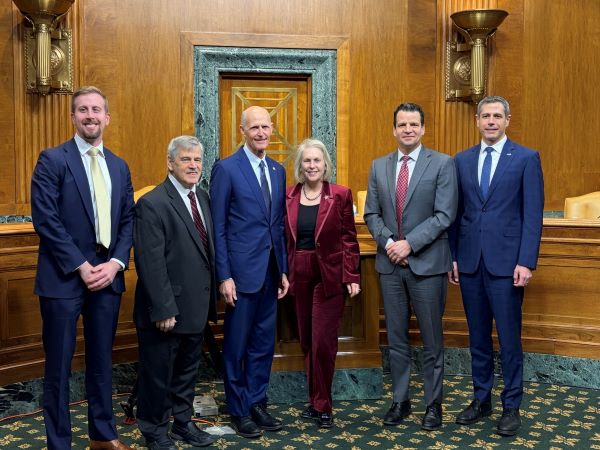
His testimony built on research presented at a September 17 U.S. Senate hearing by Gray’s co-author George Ball, associate professor at the Indiana University Kelley School of Business. The research tests one possible remedy for the increased offshoring and associated quality risk of drug manufacturing. Specifically, the authors test a policy proposal to provide country of origin labeling and a relative quality rating.
His work as the principal investigator on a $1.52 million grant focused on pharmaceutical supply chain quality and resilience also caught the legislators’ attention. A key goal of this funded work is to develop valid and reliable drug-level quality scores, which, along with location, is one of the sources of transparency Gray recommended at the hearing.
What started Gray on his search for truth in drug labeling began when he experienced FDA inspections working as an operations manager for Procter & Gamble in the 1990s.
“One of the things I wanted to study with my PhD was hidden costs and risks in outsourcing and offshoring,” Gray said. “Only late in my PhD program did I realize that FDA inspection data could be a good proxy for these risks. It was interesting because my facility never had any real issues with the FDA, every time they came in, they gave us clean inspections.”
“Before accessing FDA data, I assumed that around 95% of all plants would have clean inspections. It turns out that at the time, something like 20% had serious issues. It showed there was some real interesting variation and a lot of inferior manufacturing going on.”
Many years after beginning this pursuit, he fostered a cohort of like-minded doctors, psychologists, quality engineers, drug testers and consumer health protection watchdogs that met regularly to create and design their own research on the subject. That group provided insights he would not have obtained from just working with others in his discipline.
He also credits his work with the Industry Studies Association (ISA), where he currently serves as president, as a factor in his appearance before the Senate. The organization includes many academics well connected to policy in Washington, D.C. When a fellow member became a special assistant to President Biden for manufacturing and economic development, she and one other ISA member recommended Gray for a prestigious appointment as a consultant in the Executive Office of the President in Washington, D.C., where he provided insights and expertise related to pharmaceutical supply chain policy.
The testimony before the committee, which is chaired by Sen. Rick Scott (R-FL) and includes Ranking Minority Member Sen. Kirsten Gillibrand (D-NY), went well, Gray said. He was pleased to be a voice for this important topic.
“These senators are committed to writing legislation in this space,” Gray said. “Having the opportunity for them to read and hear what I think should be in that legislation and consider it feels really good. I think the legislation could have a huge impact on public health.”
Driving drug transparency
Gray’s research is the foundation for a new tool offered by independent, nonprofit newsroom ProPublica to help source safety information about generic drugs. Read the ProPublica article.