Connecting, collaborating and advancing AI research at Fisher

By Vicki Christian
Fisher College of Business
What started as a spark of an idea turned into Fisher’s inaugural AI Research Retreat, a half-day gathering of Fisher faculty and PhD scholars exchanging ideas and exploring emerging research around the rapidly evolving field of artificial intelligence. The retreat was designed to foster connections and collaboration within the Fisher research community.
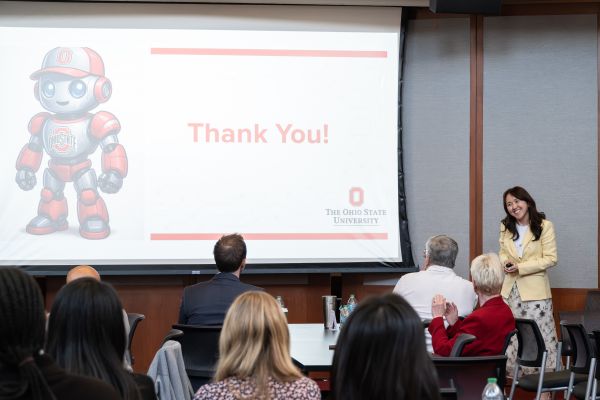
Fisher faculty members and retreat’s organizers, Yuheng Hu, Hun Lee and Alice Li created the event to help colleagues discover shared interests in AI and identify opportunities for joint projects, grant proposals and publications.
“We hope the retreat sparked new conversations, early brainstorming and the beginnings of future research ideas and partnerships,” said Hu, associate professor of accounting and management information systems. “The goal was to help cultivate an open and collaborative research culture at Fisher, where people actively share ongoing work, exchange new ideas and engage with projects at an early stage.”
The discussion of AI’s use was broad and included presentations on mental health products, crowdfunding, the online marketplace, management, human resources, medicine, operations and business analytics.
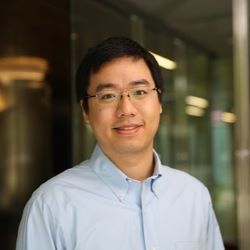
“As faculty members, we have a deep appreciation for the outstanding work being done across Fisher and wanted more opportunities to learn about our colleagues’ research,” said Lee, associate professor of management and human resources. “AI serves as a shared area of interest that can bring together different disciplines across the college.”
The retreat brought together more than 100 professors and PhD students across all five departments at Fisher to build connections through faculty and doctoral research presentations, research posters and thematic roundtable discussions highlighting AI.
“We hope colleagues are convinced that AI is inherently interdisciplinary,” said Li, associate professor of marketing and logistics. “We'd like to foster a research ecosystem, where people are encouraged to share ongoing work and early-stage ideas and projects.”
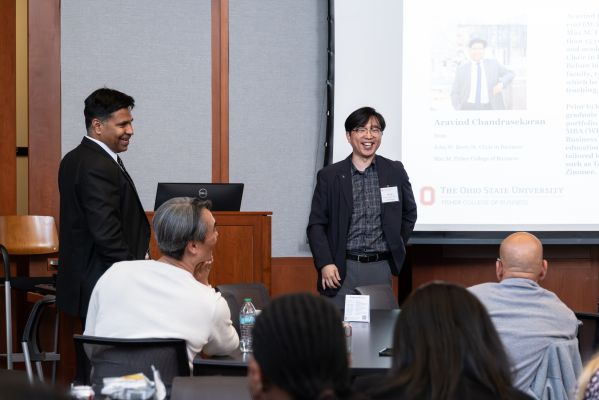
Roundtable discussion topics included the human side of AI, designing human-AI systems for teaching and learning, AI tools for academic research, inaccuracies and ambiguity in training datasets, companies operating in the age of AI and the evolving role of AI in financial services.
In addition to presentations and poster sessions, featured speakers included: Tanya Berger-Wolf, director of the Translational Data Analytics Institute at Ohio State, who discussed integrating AI, computer science and wildlife biology to advance biodiversity conservation; Nathan Laing, senior consultant at Nationwide Financial, who reviewed data-driven marketing strategy and analytics; and Mark Oleson, data scientist at the Ohio Education Research Center, who discussed economic and political theory, labor market analysis and higher education supply-demand modeling.
Lee said these presentations may prompt faculty to rethink both the questions they ask and the ways they conduct research.
“AI is opening up new possibilities for studying important problems, generating insights from data and designing research in more innovative ways,” he said.

Several faculty members who are already using AI in innovative ways presented their research on learner frameworks with GenAI, the impacts of AI-assisted learning, entrepreneurship, experimentation and ChatGPT, classroom pilots of structured AI education, and GenAI and evidence-based management.
“Per my own research, AI is a natural continuation from Bayesian statistics that is used to compute and update probabilities with new data, to machine learning, to deep learning and now AI,” said Li. “What has changed is accessibility. AI tools lower the barrier to coding, allowing colleagues who haven’t been primarily using machine learning tools or advanced programmers to conduct research that would be difficult to pursue in the past.”
Hu said that AI can improve efficiency throughout the research process and further foster innovation by helping faculty use knowledge more creatively as a tool.
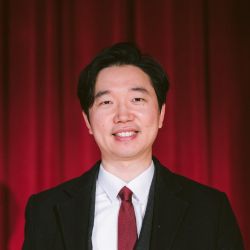
In addition, the retreat helped participants shape a shared vision for responsible, influential AI research.
“AI can improve efficiency on so many dimensions,” said Li. “But the ethics, legislation and education around these topics need to go hand in hand with the advancement of the tools.”
Lee sees how this retreat and AI can have meaningful impacts on business and society.
“I believe human-AI collaboration will be key to business success and broader societal progress,” he said. “With this opportunity, I hope we can think bigger and dream bigger about how the Fisher community can help address important business and societal challenges.”