AI Fluency at Fisher
AI Fluency Framework
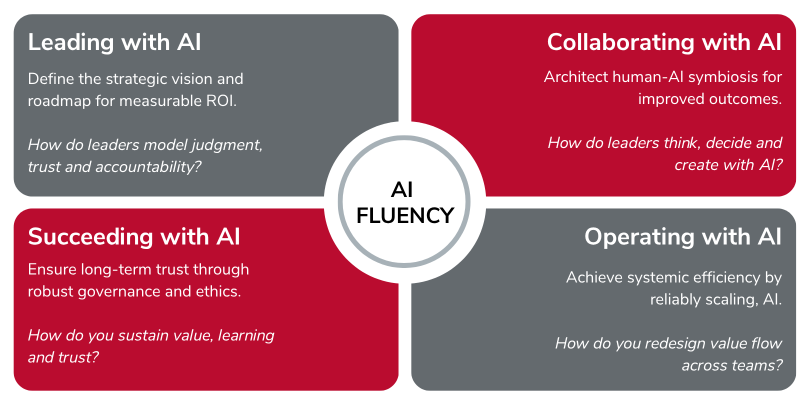
AI Fluency is the capability to confidently understand, creatively collaborate with, and critically evaluate AI, transforming it into a powerful force multiplier of your own strategic thinking and judgment. At Fisher, our AI programs are designed in alignment with The Ohio State University's Four Pillars of AI Fluency: Leading with AI, Collaborating with AI, Succeeding with AI and Operating with AI.
The AI Fluency curriculum empowers organizations and individuals to become AI ready as fast as possible.
Four Pillars of AI Fluency
Define the strategic vision and investment roadmap to drive differentiation and measurable ROI.
- Global AI Landscape
- AI-Driven Strategy
- AI Investments and ROI
- Building Adaptive Organizations
Architect human-AI symbiosis to amplify judgment, create insight, and improve outcomes.
- AI as a co-creator
- AI as an assistant
- Managing AI-embedded processes
- Measuring return on insight
Ensure long-term trust through robust governance, ethical execution and transparency.
- AI Governance, Guidelines and Guardrails
- Ethical and Safe Usage Protocols for AI
- Managing AI Risks
- Safety, Security, Transparency
Achieve systemic efficiency by reliably scaling, securing and embedding AI into the enterprise.
- AI Technologies
- Embedding AI into Core Processes
- Integrating Systems
- Securing Data Pipelines
AI Fluency Topic-Based Programs
Fisher College of Business offers a flexible portfolio of AI Fluency Jumpstarts and AI Fluency Masterclasses designed for leaders, teams and professionals at various stages of adoption. These 1- to 2-day programs are built to be practical, experiential and stackable, allowing you to build skills quickly or deepen expertise over time. Explore our AI-focused offerings below to find the option that best fits your goals, level of experience and responsibilities.
-
AI Jumpstart for Executives
Build essential AI fluency fast so you can lead confidently, identify high‑value use cases, and reduce risk. This one‑day experience gives executives a clear understanding of what AI can do and how to act on it immediately.
-
AI Fluency Masterclass for Supply Chain
Explore how AI technologies, from generative AI to agentic AI, are transforming supply chain planning, operations, and strategy. This program helps professionals evaluate AI solutions and apply them to improve decisions and performance.
Customized AI Fluency Programs from Fisher College of Business Executive Education
We provide training across the four pillars of fluency to ensure success in your AI journey. With expert faculty curating an array of 2-day and customizable programs, our state-of-the-art approach to AI education is here to support you every step of the way.
Launch, accelerate and empower your AI journey with selections from our digital and in-person programs.
- AI for HR and People Leaders
- The Future of Supply Chain with AI
- AI-Enabled Visual Marketing
- AI Governance, Guidelines and Guardrails
- AI Trends and Technologies
- Context Engineering for AI
Customizable programs tailored to the needs, workflows and decision contexts of distinct leadership groups.
- Executive Leadership & Strategy
- How AI reshapes competitive advantage, governance & strategy
- Marketing & Sales Teams
- AI for personalization, pipeline growth, content scaling and analytics
- Product & Innovation Teams
- AI-driven product road-mapping, feature prioritization, and prototyping
- Operations & Finance Leaders
- Process automation, forecasting, efficiency and risk management
Programs customized to the unique opportunities, use cases, constraints and growth levers of your industry.
- Insurance
- Claims automation, risk modeling and underwriting decision support
- Banking and Financial Services
- AI in risk scoring, customer service and advisory workflows
- Consumer Packaged Goods
- Demand forecasting, optimal pricing, consumer insights and analytics
- Healthcare, Manufacturing, Retail, and more
Allow us to customize a program focused on the strategic outcomes your organization seeks to achieve. For example:
- Increasing efficiency and reducing operational cost
- Unlocking new revenue streams or business models
- Improving customer experience and retention
- Accelerating innovation velocity across teams