Buckeyes and Coca-Cola partners bring innovation to campus sustainability

By Vicki Christian
Fisher College of Business
As a Boy Scout, Thomas Moore earned a merit badge for conservation projects focused on sustainability, recycling and reducing waste. Now, as a college student living in his own apartment, he understands more clearly how much waste we generate, what it takes to be earth-friendly and the barriers that exist.
Similarly, Szilvia Wiksell finds the process of knowing what is recyclable and compostable to be a bit daunting.
“I wish I could incorporate it more,” said Wiksell, a rising fourth-year public health and public policy student at Ohio State. “It's just so hard to figure out, ‘Is this compostable? Is this recyclable? Is this supposed to go in the trash?’”
Fellow Buckeye Caden Young, a rising fourth-year finance and accounting student, feels the same way. He’s often scared to try to recycle something, worried that he might ruin a recycling operation.
When the opportunity presented itself during spring semester to work on a project to make Ohio State more sustainable, the students jumped at the chance.
“The fact I got to work with sustainability on campus and could see areas that I interact with daily and could make a direct impact on was very useful and interesting,” said Moore, a rising fourth-year biomedical engineering student and part of the Integrated Business and Engineering honors program.
In partnership with The Ohio State University, Coca-Cola Consolidated and The Coca-Cola Company, all three Buckeyes joined the Student Experience Technology Push Program facilitated by the Center for Innovation Strategies (CIS), where they each were part of a team finding “green” solutions for Ohio State.
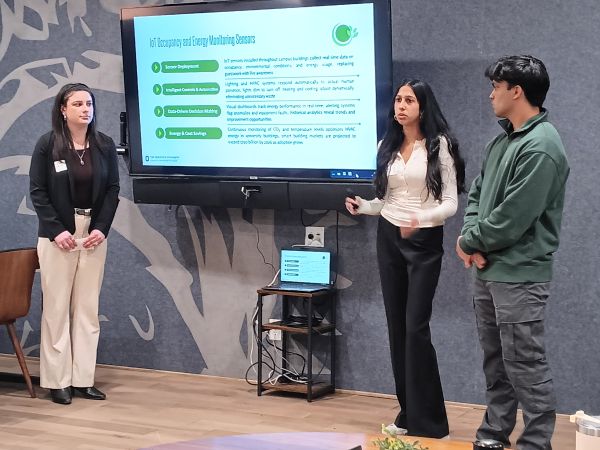
The student-generated proposals were a part of a multi-year sustainability partnership connecting student teams from across Ohio State to develop unique solutions to energy use, recycling and waste management. In addition to the Student Experience Technology Push Program, CIS also implemented a Student Experience Research Accelerator, an undergraduate program examining the behavioral and cultural factors that influence recycling and composting participation.
Two additional projects were launched in 2026 including the Sustainable Energy Accelerator, an energy-related challenge presented by Coca-Cola Consolidated, and a year-long Zero Waste Challenge at the Ohio Union with partners across Student Life, Facilities Operations and Development and the Sustainability Institute.
The grant was established to foster research on companies and startups across the world that are developing technology-based solutions that increase recycling and composting efficiency.
Game day wins at Ohio Stadium
Moore and his teammates ― Alivia Busi, a rising fourth-year industrial design student, and Menghan Zhu (BSBA ’26), a management information systems graduate ― found food waste to be a university-wide problem.
“We saw a large area of opportunity on home game days,” Moore said. “With a lot of new people coming in there’s a lot of waste generated, and we saw different ways we could apply sustainability to Ohio Stadium.”
His team’s sustainability proposal, “The Perfect Gameday Experience,” employed the use of AI smart bins, an AI food waste tracking system and on-site micro composting, combined with a live dashboard and gamification of section-based competitions or rewards.
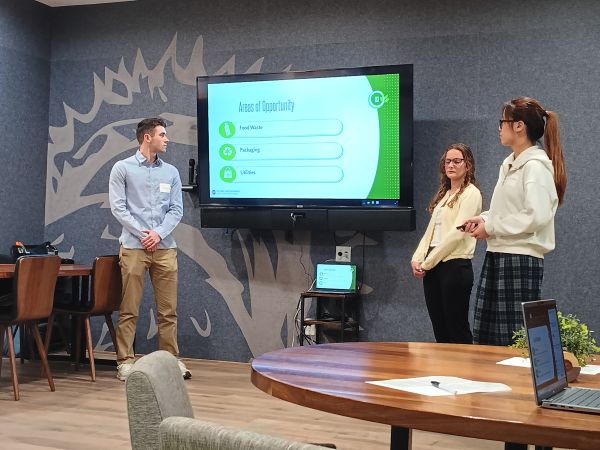
“We did background research and talked with Ohio State’s Facilities Operations and Development (FOD) to find similar solutions being used, as well as areas of opportunity that could be optimized on campus,” said Moore. “We then focused on refining our selection, developing business models and market fit for those technologies.”
Although Ohio Stadium already diverts more than 90% of its waste from landfills, the team identified opportunities to further improve the sustainability efforts. The team proposed incentives for fans to return their reusable food packaging after each home game. One suggestion included placing a $5 deposit on a customer’s credit card until the used packaging, identified by a Near Field Communication (NFC) tag, is returned to a designated smart-tagged bin. The deposit is refunded once the bin sensor scans the NFC tag.
“The idea behind it is like Aldi's, where you have to insert a quarter to get a shopping cart, but is returned when the cart is returned,” said Moore.
The team also created a sanitation pilot, the Buckeye Utility Control and Knowledge System (B.U.C.K.S.), using sensors for real-time visibility of the water, energy and sanitation needed throughout the stadium to run restrooms, concessions and heating and cooling needs.
Behavioral nudging with AI
Wiksell’s team focused on AI automation using an app and trash sensor to help individuals identify and determine whether something was recyclable.
Her teammates ― Vaishali Ramakrishnan, a rising third-year computer science and engineering student, and Ved Srivastava, a rising third-year finance and economics student ― worked on different sensor options that could tell the weight and material of an object when it’s thrown away. The sensor would then indicate how to dispose of it properly by either composting or recycling it.

The app included an incentive to earn points for rewards.
“I went on my own little internet scavenger hunt and started searching for cool AI methods that would work for sustainability on campuses,” Wiksell said. “I stumbled upon an article from Universidad Politécnica de Madrid about how they were implementing an app and saw a huge reduction in waste.”
To encourage use of the app, Wiksell focused on using behavioral nudging: providing psychological cues that subtly guide decisions.
“I took that psychology term and ran with it, using AI automation to see if you could nudge people in the right direction of composting and recycling correctly,” Wiksell said. “Every time you tell the app what you are looking to recycle, it gives you points. After a certain amount of points, you get a reward like extra money on your Buck ID or a gift card.”
Water down the drain
Young appreciated the opportunity to explore and use emerging technologies throughout the Coca-Cola-sponsored project.
“I feel like a lot of the focus is on recycling or composting, but water consumption is a really big thing, especially at the university’s research buildings,” said Young.
To help reduce consumption, his team offered a number of recommendations, including:
- an expansion of the sub-metering system to track real-time consumption at the building level
- smart sensors
- localized reclamation systems to recycle unusable graywater for non-potable campus needs
He and his teammates ― Nathan Chow, a rising fourth-year aerospace engineering student, and Aashish Prabakaran, a rising fourth-year finance student ― also found that leaks and breaks in the university’s aging infrastructure and delayed response times can result in the loss of millions of gallons of water.
“One of the big cost factors for Ohio State was not only water consumption but water leaks and underground pipes,” Young said. “I noticed a lot of the repairs were reactive. That's where I came across self-healing pipes that release a chemical compound through a capsule once the pipe is damaged. If a leak is able to be self-repaired, you don't need to dig up where that pipe is and take weeks to fix it.”
Applying classroom knowledge to sustainability
For Moore, the Technology Push Program was a good way for him to apply his business and engineering studies to a real-world problem.
“As an engineer, I used my problem-solving mindset to look at the issue, break it down, and identify key areas where I thought there could be improvement,” Moore said. “On the business side, I developed user personas to better identify the market we were trying to address, conducted ROI analysis and identified value propositions. We then used these skills to market our solutions.”
“I was really able to take the business concept from start to final presentation, which is very useful to better understand the process that a company's going through when they're developing a new product or idea.”
For Wiksell having the engineering and business insights from her teammates, along with her public health and public policy perspective, helped her team tackle their project from very different angles.
“It was really cool to see the different perspectives each of us had,” she said. “Having me focus on the health side of things, and Ved, as a business major, focus on the economics and how it would be financially feasible, made our project more dynamic.”
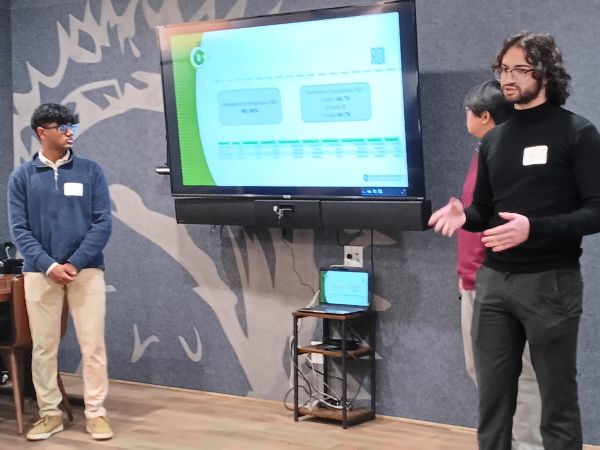
Young also appreciated having outside perspectives.
“Nathan had more of a scientific method of thinking about things, while Aashish and I were more focused on cost and monetary things,” Young said. “It was pretty cool to have two different perspectives. I saw the cost that it takes to fix the pipes, whereas Nathan was helping find the scientific emerging technology for us.”
By working through CIS, the students also learned about innovation, including that it’s not always a linear path as some might think.
“Innovation is an iterative process until you find a solution you can be happy with,” Moore said. “It takes perseverance.”
Wiksell found that innovation is hard to get going and push forward, requiring money, group effort and time.
“The program has definitely been invaluable,” said Moore. “The CIS staff help drive an innovation mindset and teach you how to approach problems you would otherwise look at as daunting. They promote free thinking and problem solving. Here, you're given the ability to be more creative.”
“I was really able to take the business concept from start to final presentation, which is very useful to better understand the process that a company's going through when they're developing a new product or idea.”