The AI Fluency Framework
What the research shows
Access without judgment creates the illusion of progress.
Workers with AI assistance outperformed peers, but only when they understood the task well enough to evaluate the output (MIT).
Organizations report productivity gains but consistently struggle to translate them into competitive advantage (McKinsey).
Heavy AI users show measurable decline in independent problem-solving capacity over time (Microsoft Research).
AI Fluency is choosing to stay in the loop when AI makes it easy to opt out. The real risk isn't your job. It's the thinking you stop doing. What you stop practicing, you slowly lose.
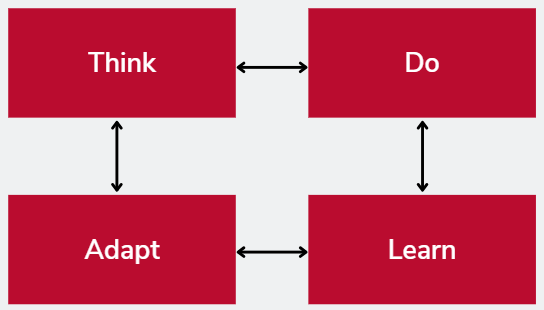
Human agency stays in the loop. What you stop practicing, you slowly lose. AI Fluency is built through active cognitive engagement.
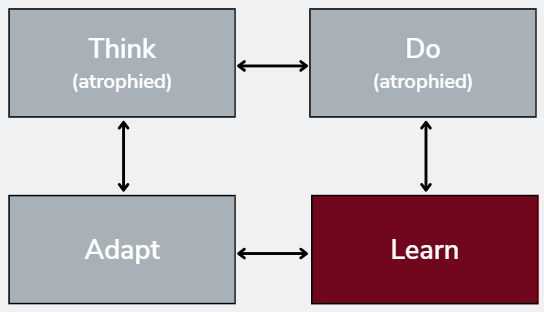
Passive AI use. Capability atrophies quietly.
The Ohio State Framework
Five practices. One thinking system.
Conceptual Clarity
Conceptual Clarity (Think)
- Staying bilingual at depth — your domain and AI — so you can tell when the machine is wrong.
Critical Evaluation
Critical Evaluation (Learn)
- Interrogating AI output before accepting it as value. The skill nobody is developing.
Creative Exploration
Creative Exploration (Do)
- Thinking across domains, not just deeper into familiar ones. AI as the universal passport.
Constructive Collaboration
Constructive Collaboration (Adapt)
- Building with AI as a genuine thought partner, not a vending machine.
Cognitive Ability
Cognitive Ability (Reinforcing Loop)
- The meta-practice that keeps the rest current as the technology changes.
Four domains. One framework. Built for organizations.
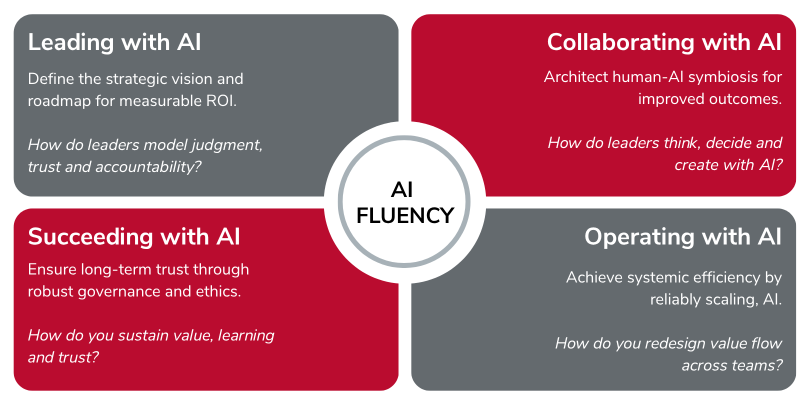
Define strategic vision and roadmap for measurable ROI.
- How do leaders model judgment, trust and accountability?
Architect human-AI symbiosis for improved outcomes.
- How do leaders think, decide and create with AI?
Achieve systemic efficiency by reliably scaling AI.
- How do you redesign value flow across teams?
Ensure long-term trust through robust governance and ethics.
- How do you sustain value, learning and trust?