AI Is Everywhere, Value Is Elusive

The race to deploy AI is outpacing the strategic work required to create business value.
Artificial intelligence is now a standing agenda item in boardrooms. Executives across industries are asking the same questions. What is our AI strategy? Where are we using AI today? How quickly are we moving?
Teams are launching pilots, experimenting with generative AI tools, and exploring automation opportunities. The pressure to act is clear. Every organization feels it must do something with AI. Yet moments like this have occurred before.
Transformative technologies tend to follow a familiar trajectory. Early breakthroughs create new capabilities and organizations rush to experiment. Over time the technology spreads across industries and becomes widely accessible. When that happens, the source of competitive advantage shifts.
Research from MIT Sloan Management Review shows that companies succeed in digital transformation not primarily because of the technology itself, but because leaders redesign strategy, culture, and operating models around it. Once a technology becomes widely available, advantage moves from access to execution. Artificial intelligence is entering that phase now.
A Familiar Pattern: Lessons from the E-Commerce Era
Looking back at earlier technological disruptions helps clarify the moment organizations face today. The rise of e-commerce in the late 1990s offers a useful example.
During the dot-com boom, internet startups appeared overnight. Established retailers quickly realized they needed an online presence. Websites launched rapidly and digital initiatives multiplied.
Many companies experimented with online retail but treated it as an additional channel layered onto existing operations. Digital storefronts were built without rethinking logistics, supply chains, pricing models, or customer experience.
Other companies built their entire operating models around digital commerce. Amazon designed systems in which technology shaped how inventory moved, how orders were fulfilled, and how customers interacted with the business. That integration proved decisive.
Several legacy retailers struggled to adapt. Montgomery Ward closed its remaining stores in 2001 after failing to keep pace with the shift toward digital commerce. Companies like Sears and Toys “R” Us launched online initiatives but never integrated them into a coherent strategy.
The lesson is straightforward. Technology adoption alone rarely creates value. Competitive advantage emerges when leaders integrate innovative technologies into strategy, operating models, and decision systems. The same pattern is now unfolding with artificial intelligence.
The Discipline of Strategic Technology Integration
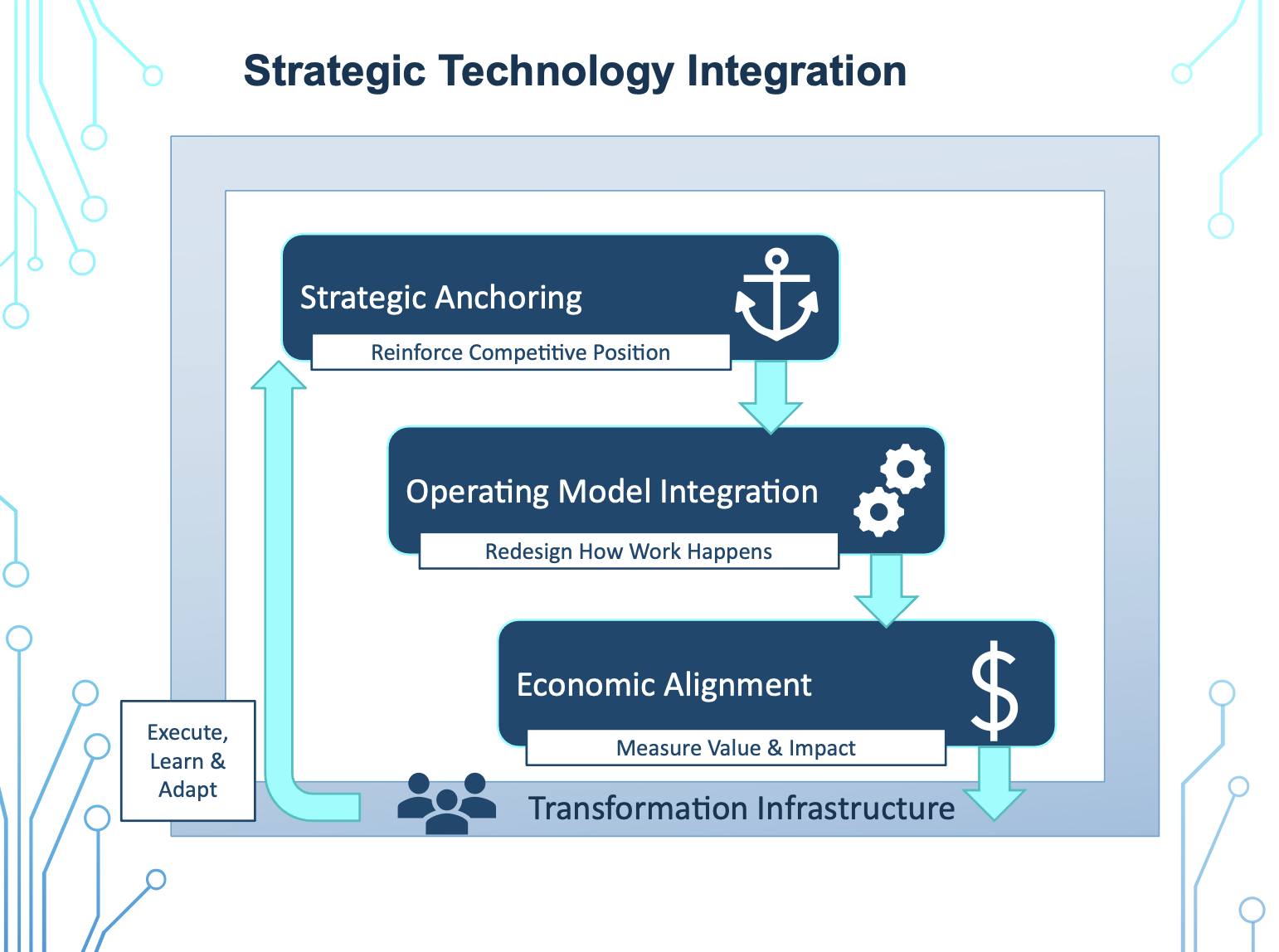
If AI is becoming table stakes, the real differentiator will not be the technology itself. It will be the leadership discipline required to integrate that technology into the organization.
This capability can be described as strategic technology integration. It is the executive ability to translate emerging technologies into competitive advantage by aligning them with strategy, operating models, and measurable outcomes.
This discipline applies to any major technological shift. It has shaped how organizations adopted e-commerce, cloud computing, and automation. AI amplifies the importance of this capability because of the scale of change it introduces.
Leaders who successfully integrate transformative technologies tend to follow four core disciplines.
Strategic Anchoring
Technology initiatives must begin with strategy. Leaders must first clarify the competitive position they are trying to build or defend and how technology strengthens that position.
Michael Porter’s work on competitive strategy highlights the importance of clear positioning, whether through cost leadership, differentiation, or focus. AI should be evaluated through this lens. Does it reinforce advantage, extend it, or reshape it?
Without this anchor, technology initiatives fragment into disconnected experiments.
Operating Model Integration
Once strategy is clear, technology must be integrated into how the business actually operates.
This means changing workflows, decision-making structures, and roles. Research in digital transformation consistently shows that technology only creates value when operating models evolve alongside it.
Outcome Definition and Economic Alignment
After strategy and operating design come outcomes. Leaders must define success in measurable business terms.
This includes cost reduction, revenue growth, risk reduction, and performance improvement. Without clear metrics, organizations often mistake activity for impact.
Transformation Infrastructure
Execution requires infrastructure. Governance, roadmaps, capability development, and change management must all be in place.
But this should not be the starting point. Many organizations build transformation teams before defining strategy and outcomes. That sequence rarely produces value.
The Leadership Test
Artificial intelligence can feel intimidating. The technology is evolving quickly, terminology is unfamiliar, and pressure to act is constant. That pressure often produces two traps: hesitation and overconfidence.
Psychologists David Dunning and Justin Kruger identified a cognitive bias where individuals with limited knowledge overestimate their understanding. Emerging technologies often amplify this effect. Early exposure to powerful tools can create the illusion that value is easy to achieve.
Recent enterprise research reinforces this challenge. A multi-method study examining more than 300 AI initiatives across dozens of organizations found that despite tens of billions of dollars invested, roughly 95 percent of companies are seeing no measurable return from their AI efforts. Only a small fraction of initiatives produce meaningful financial impact.
Researchers describe this as the “GenAI Divide.” Many organizations are experimenting with AI, but far fewer are integrating it into how their businesses actually operate.
Capturing value from AI does not require executives to become machine learning experts. It requires applying the same leadership disciplines that have always determined whether organizations successfully adopt transformative technologies.
These responsibilities cannot be delegated entirely to transformation teams, consultants, or vendors. They sit with leadership.
Artificial intelligence is rapidly becoming part of the operating environment. The real question is simple.
How will your company operate differently in an AI-enabled world?
Answering that question has always been the work of leadership.
Sources
- MIT Sloan Management Review. Strategy, Not Technology, Drives Digital Transformation. 2015.
https://sloanreview.mit.edu/projects/strategy-drives-digital-transformation/ - Challapally, Aditya, et al. State of AI in Business 2025: The GenAI Divide. MIT Project NANDA.
- Kruger, Justin, and David Dunning. Unskilled and Unaware of It. Journal of Personality and Social Psychology, 1999.
- Porter, Michael E. Competitive Strategy. Free Press, 1980.
Eager to learn more about AI strategy? Sandeep Chennikara and Blake Mohseni will lead a COE Summit breakout session on why AI fails to deliver ROI and how to create real value using process thinking.
The Ohio State University Center for Operational Excellence Summit, now in its 13th year, is a three-day event dedicated to connecting diverse industries to the latest best practices in leadership and continuous improvement. This year’s Summit will explore how organizations are rewiring excellence with emerging tech, bold strategies, and future-ready thinking. Top authors, researchers, and lean practitioners will share insights on operationalizing AI, innovating processes, and navigating disruption with clarity and confidence.