Beyond the Books: How the OSU MAcc Program Builds Technical and Professional Skills
The Master of Accounting (MAcc) program is a great way to not only develop technical accounting knowledge, but also essential leadership and soft skills. The program is designed to thoughtfully incorporate diverse electives, a STEM-Designation curriculum, and to create well-rounded accounting professionals.
The MAcc curriculum strategically extends beyond core accounting topics, offering Finance and Human Resources elective options. These elective options allow students to expand their overall business knowledge and build soft skills. The combination of rigorous accounting, supplementary business knowledge, and data analytics creates a strong foundation for modern professionals.
The program’s courses simulate real-world professional scenarios. The assignments within these courses include, but are not limited to, group projects, presentations, detailed case studies, and individual analysis. The necessity of managing multiple group assignments throughout the first quarter has instilled time management and organizational discipline. These skills will be directly applicable to team collaboration and meeting management in the professional workplace.
Additionally, multiple opportunities for presentations have given me the opportunity to strengthen my public speaking skills. The ability to confidently speak is a vital asset for entering the accounting industry, including public accounting. This skill is important when communicating with peers, partners, and clients in the public accounting industry.
Furthermore, many courses are structured around case studies. Case studies are an effective way to improve critical thinking and on-the-spot problem solving skills. These environments rely on active participation and occasionally “cold calling.” Although this may seem intimidating, they are a great way to prepare for the fast-paced professional environments.
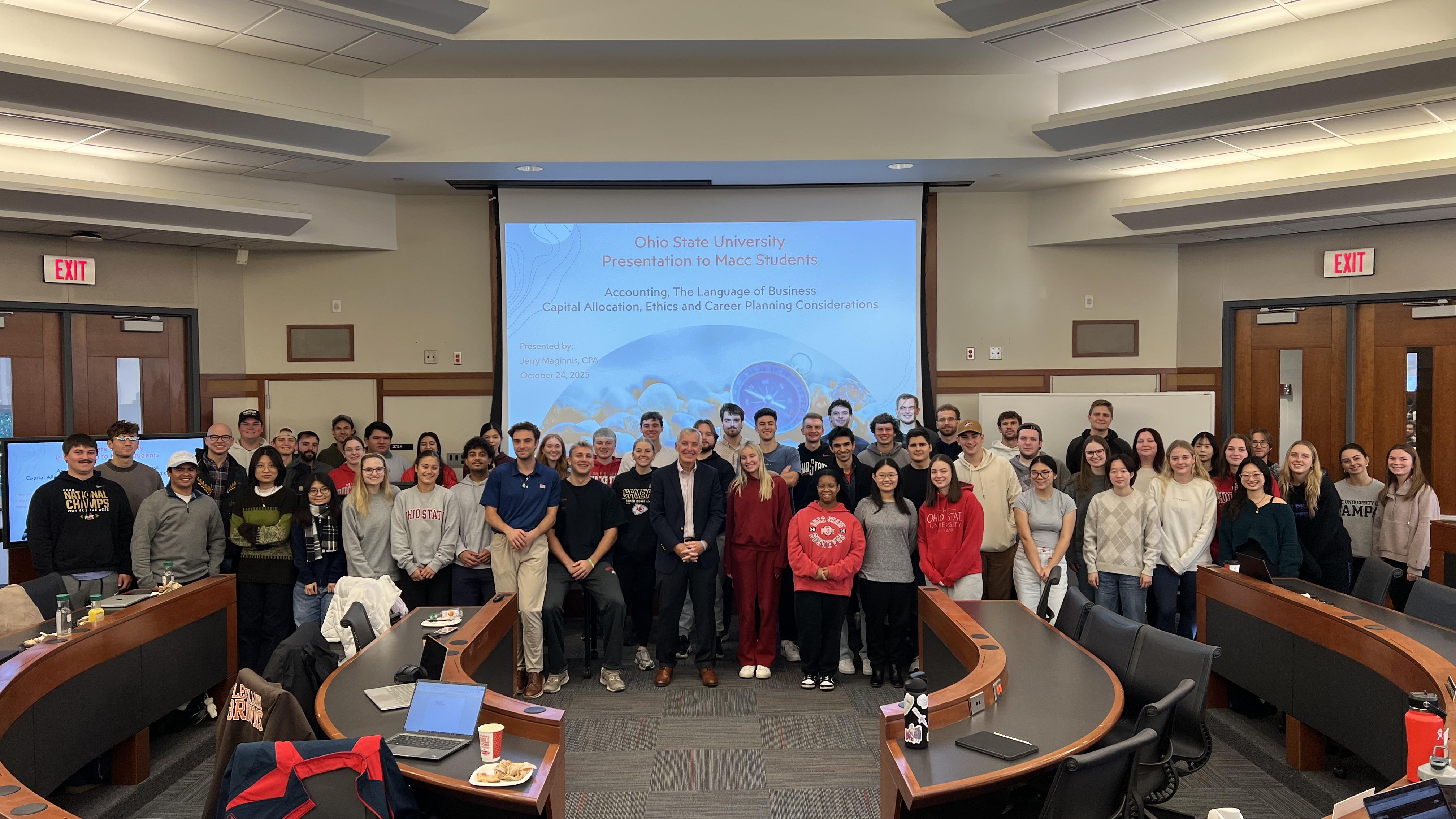
An additional opportunity that the MAcc program offers is MAcc Talks. Throughout the program, speakers are brought in to discuss various topics and expose student to different topics and career opportunities. One of the recent MAcc Talks featured Jerry Maginnis who discussed his experiences and different aspects of our early careers.
Within the talk, there were many takeaways, but a few points stuck out. First is the art of asking questions. In the academic setting and the professional setting, especially at the beginning, young professionals need to learn how to ask questions. Not only do we need to formulate educated questions, but to do so without attacking, making unprompted suggestions, or appearing as disrespectful. Sometimes our curiosity may not come across as we would like. Building this soft skill can be monumental in the beginning of our careers. An additional takeaway is the importance of being well-rounded and personable. When accountants take their technical skills and continue to be personable and ask questions, they can set themselves up for success. Becoming an accountant can give you a “seat at the table.” The profession provides many opportunities in a variety of in different industries, and by keeping these ideas in mind, your career opportunities can be endless.
Overall, the MAcc program is effectively building a foundational expertise that integrates both technical and professional skills. The program is successfully equipping me with essential critical thinking, communication, and leadership skills necessary to transition into the professional environment.