Cookies, Cases, and Crunch Time: An MBA Case Competition Story
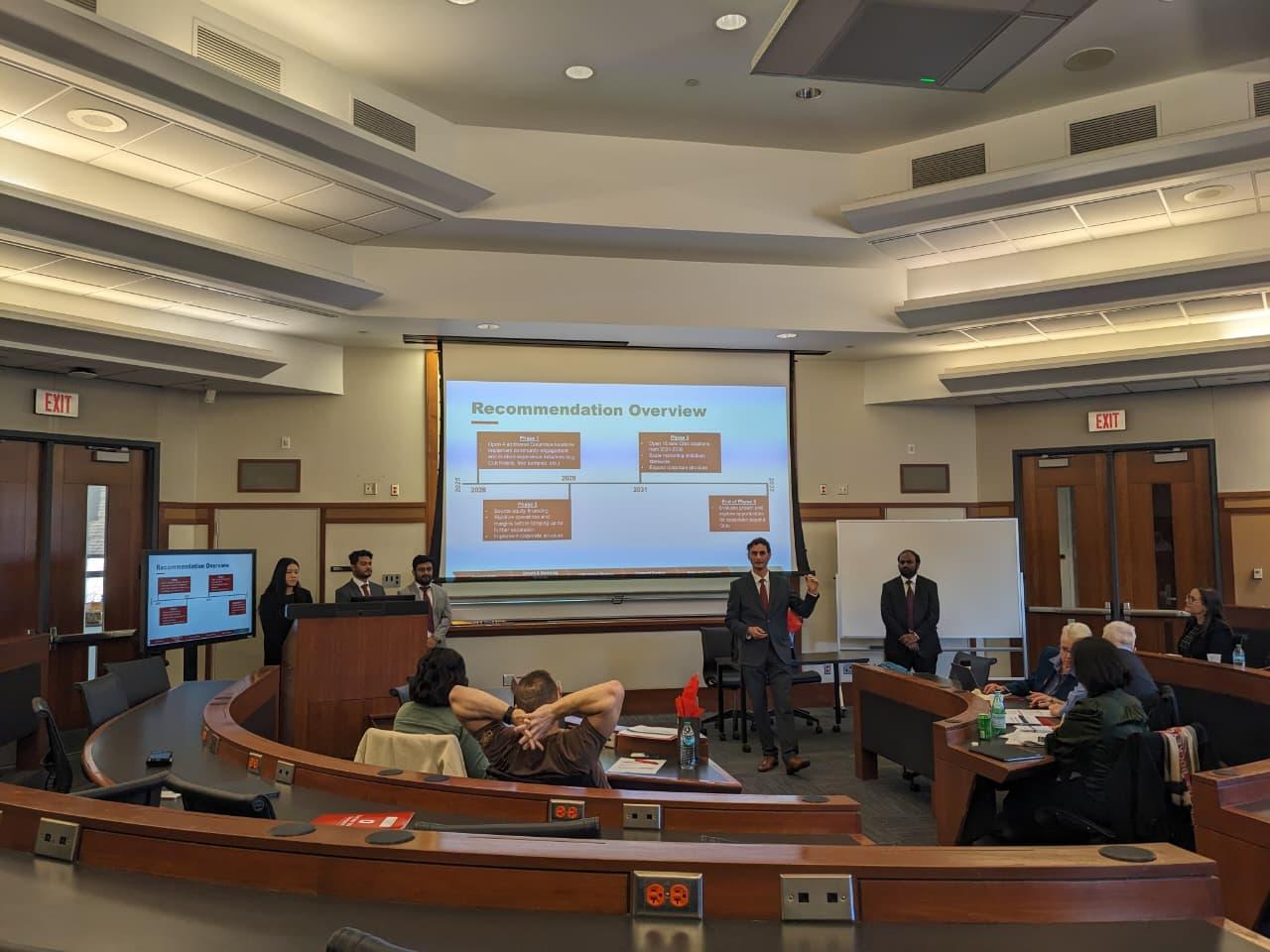
One of the most talked-about aspects of an MBA program is case competitions. Most of these competitions are optional, requiring students to take the initiative to register and form teams. However, we had a mandatory case competition to close out the semester. While it was not graded, it offered prizes and the opportunity to represent our college at the national level, an incentive strong enough on its own.
On paper, a case competition sounds straightforward. You are given a real-world client’s problem, provided with relevant data, and tasked with developing and presenting a solution to a panel of judges. This year’s case featured the USA’s #2 cookie company, Lion’s Cub Cookies (LCC), one of the highest-rated cookie shops in Columbus with locations in Grandview and Worthington. Our objective was to recommend a staged growth strategy across 3-, 5-, and 10-year horizons, with particular emphasis on the 3- and 5-year plans, detailing how LCC should expand, finance, and organize for sustainable success.
The case was released on December 7, right in the middle of final exams, which meant we could only begin in earnest after completing our last exam on December 10. Like most MBA experiences, this required quickly shifting gears and juggling competing priorities. Within a few short hours, we had to thoroughly analyze the case and prepare questions for the LCC owner. With eight additional teams participating, a wide range of questions were raised and addressed, giving us valuable insight early on.
The following day was dedicated entirely to preparation. OSU provided food, snacks, and accommodation, allowing us to stay focused throughout the day. We began at 8:15 a.m. and moved into our designated rooms to collaborate as a team.
How We Prepared for the Case Competition:
- Understanding the case thoroughly – We began by carefully reading and analyzing the case to understand the problem statement, objectives, constraints, and expectations. The concepts taught in our courses helped us analyze the case systematically and apply our knowledge to real-world problems.
- Research and data collection – We conducted market research and studied industry trends, competitors, and real-world examples to support our analysis and recommendations.
- Team brainstorming and idea generation – Multiple brainstorming sessions were held to discuss different perspectives, challenge assumptions, and generate innovative solutions. Our varied coursework helped us view the business from multiple angles like operations management (bottlenecks and centralization) and marketing (the 4Ps), among others.
- Role allocation within the team – Tasks were divided based on individual strengths (analysis, finance, marketing, strategy, and presentation design), which improved efficiency and collaboration. Since there were five of us on the team, we applied the concept of divide and conquer.
- Applying frameworks and concepts – We used business frameworks and concepts such as SWOT and financial analysis to structure our approach logically. Thanks to Prof. Chad Zipfel, we knew how to calculate the NPV of the project and how to use various bank covenants to arrive at appropriate loan amounts.
- Developing feasible and practical solutions – Our focus was on creating realistic, implementable strategies rather than purely theoretical ideas.
- Preparing the presentation – We worked on structuring the presentation clearly, designing concise slides, and ensuring a strong storyline. Courses such as Professional Development, taught by our beloved Dr. Lori Kendall, formed the backbone of our presentation. Previous workshops and mock class presentations helped us build the confidence needed to present effectively.
- Practice and feedback – The team rehearsed multiple times, refined content based on each other’s feedback, and improved clarity, confidence, and time management.
The final day was dedicated to presenting to the client in a two-stage competition format, with teams advancing from Stage 1 to Stage 2. While we did not ultimately win, the experience delivered something far more valuable, the opportunity to apply classroom learning to a real business challenge under time pressure. The lessons gained from this case competition will stay with us well beyond the semester.